
![Samsung Smart TV 65-Inch Mini LED M72H 4K, UHD TV, Mini LED HDR, Motion Xcelerator, Dynamic Sound Pack, AI Companion for questions [2026]](https://zivzi.co.uk/wp-content/uploads/2026/09/samsung-smart-tv-65-inch-mini-led-m72h-4k-uhd-tv-mini-led-hdr-motion-xcelerator-dynamic-sound-pack-ai-companion-for-ques-150x150.jpg)
Samsung Smart TV 65-Inch Mini LED M72H 4K, UHD TV, Mini LED HDR, Motion Xcelerator, Dynamic Sound Pack, AI Companion for questions [2026]
September 15, 2026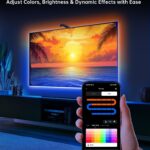
LED Backlight, 14.7ft Cuttable TV Lights with Sensor for 55-65 Inch Screen
September 15, 2026![TV LED Backlight with 4-Zone Sensor, RGB Color Sync for 55-65 Inch TV, 4.5M [Energy Class G]](https://zivzi.co.uk/wp-content/uploads/2026/09/tv-led-backlight-with-4-zone-sensor-rgb-color-sync-for-55-65-inch-tv-45m-energy-class-g-1009x1024.jpg)
TV LED Backlight with 4-Zone Sensor: Quick Product Overview
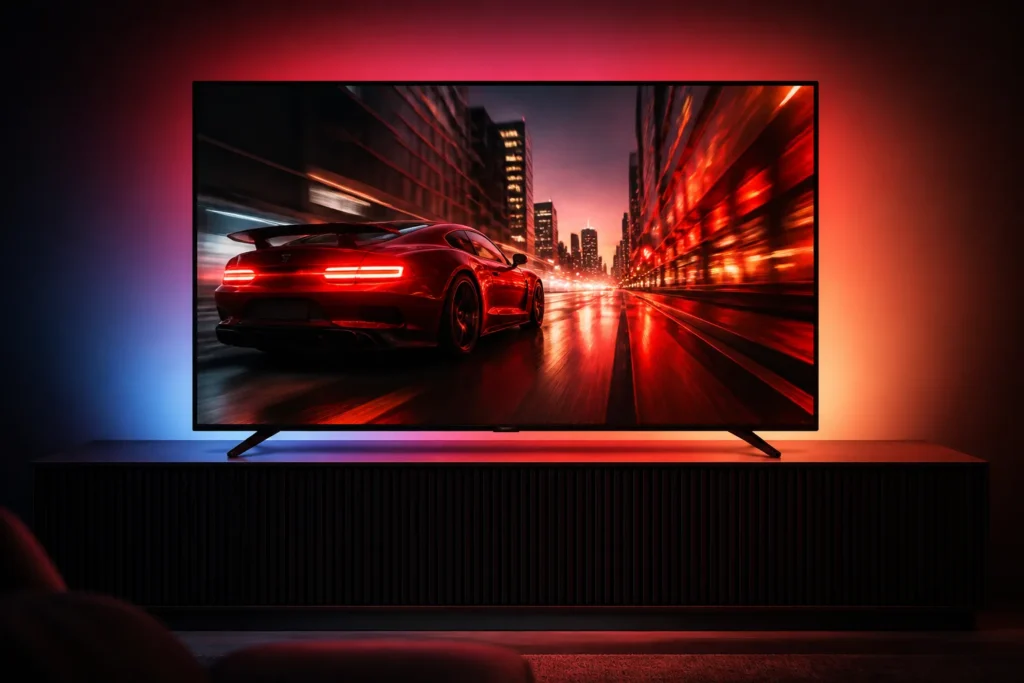
A screen-synchronised lighting system can add atmosphere, but a simple strip that shows one colour around the whole television won’t suit every scene. This TV LED backlight uses a top-mounted sensor designed to divide the display into four areas and match the surrounding RGB lighting to the colours on screen.
The product is a 4.5M lighting setup for 55–65-inch ultra-thin televisions. Its central promise is more directional ambient colour: different parts of the light are intended to reflect separate parts of the picture instead of treating the entire display as one colour field.
At the listed price of USD0.00, the question is less about whether the feature list is extensive and more about whether the listing is accurate and whether four-zone syncing makes a noticeable improvement over a simpler single-zone light. This review examines installation, app controls, automatic behaviour, compatibility, and the limitations in the supplied information.
The listed Energy Class G rating is included in the product name. It identifies the stated energy class, but the available data does not provide enough information to calculate electricity costs. In short, this TV LED backlight looks most interesting if you want active colour matching rather than a fixed-colour strip, while the missing customer and power-consumption data call for some caution.
![Discover more about the TV LED Backlight with 4-Zone Sensor, RGB Color Sync for 55-65 Inch TV, 4.5M [Energy Class G].](https://zivzi.co.uk/wp-content/uploads/2024/02/purchase-now-light-blue-11.png "Discover more about the TV LED Backlight with 4-Zone Sensor, RGB Color Sync for 55-65 Inch TV, 4.5M [Energy Class G].")
TV LED Backlight Compatibility and Physical Setup
This TV LED backlight is specified for televisions between and inches and for ultra-thin sets no thicker than 1.57 inches. Those limits are not minor details: a television outside either boundary may leave the lighting poorly positioned or the sensor unable to sit securely.
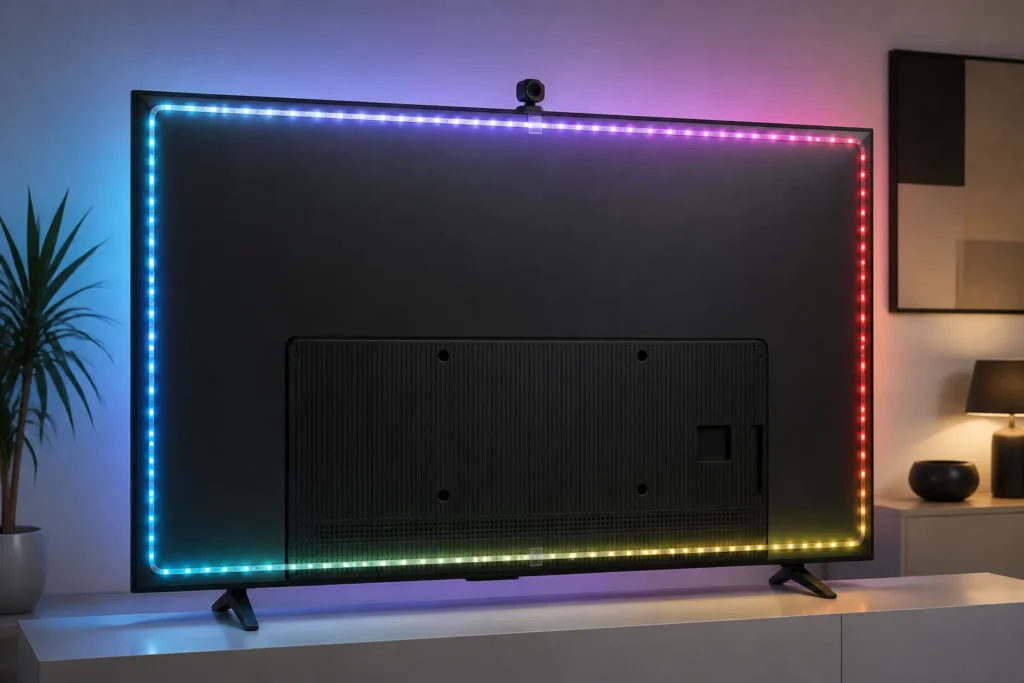
The camera-style optical sensor uses a gravity-mounted design. It sits on top of the television and can be adjusted, so you should check that the top edge is stable enough to support it without blocking the screen or being obstructed by another device.
The lighting itself is intended to attach to the rear of the TV with the included adhesive strip. The product description presents this as a straightforward alternative to complicated brackets, but the supplied information doesn’t establish how the adhesive performs over extended use or on every rear-panel finish.
- Clean the rear surface so dust or residue doesn’t interfere with the adhesive.
- Plan the route around the television before removing any backing from the strip.
- Attach the adhesive and position the lighting around the rear of the set according to the included instructions.
- Place the gravity-mounted sensor on the top edge and adjust its position for a clear view of the screen.
- Connect the system as directed and check that the sensor remains stable before using synchronised modes.
Before choosing this TV LED backlight, inspect the TV’s size, thickness, available rear mounting surface, and top-edge shape. A narrow or unsuitable upper edge could make the sensor placement impractical even if the screen size appears to fit.
How the 4-Zone TV LED Backlight Sync Works
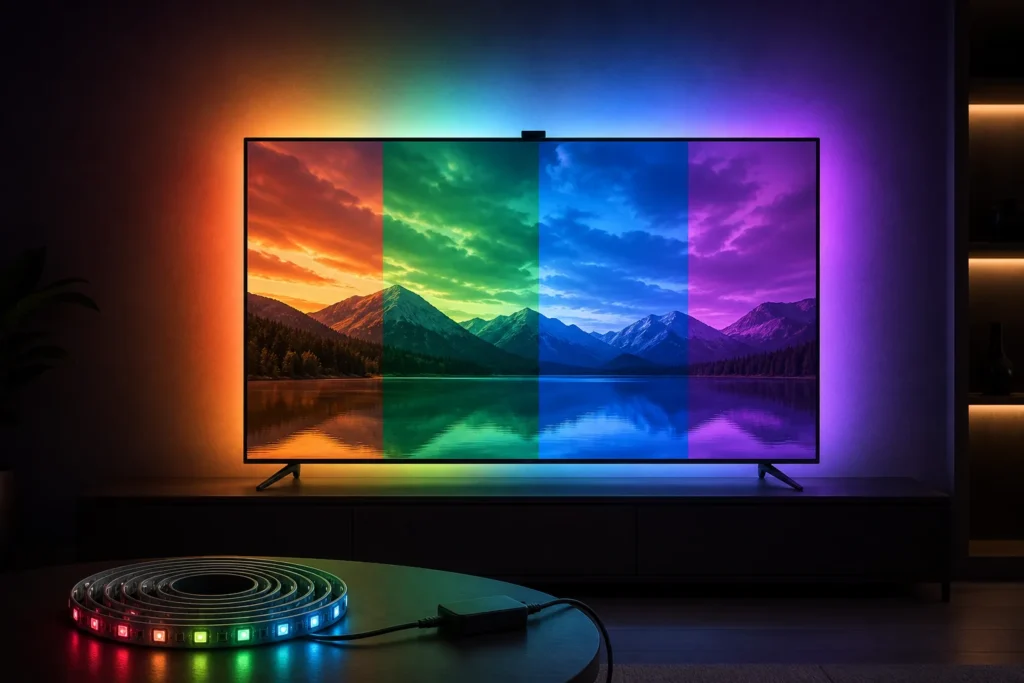
The key difference in this TV LED backlight is the four-zone approach. The top-mounted sensor is described as capturing colour information from four independent areas of the display, allowing the lighting to respond to different sections rather than selecting one dominant colour for the entire screen.
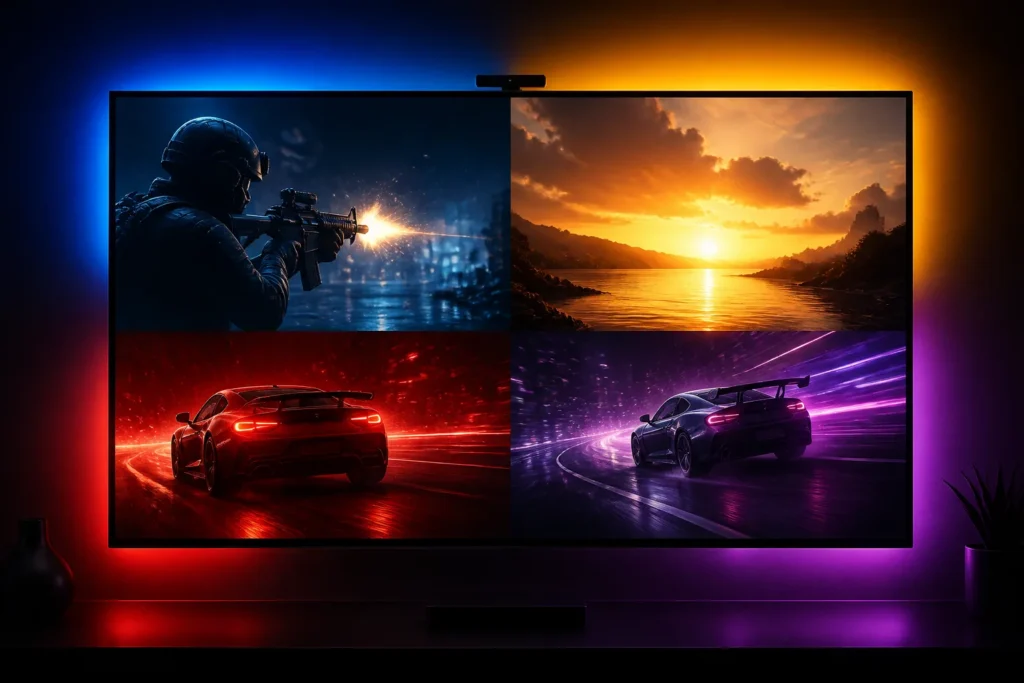
LAVON colour-matching technology is described as detecting on-screen action frame by frame and extending the visual effect beyond the bezel. The intended examples include a muzzle flash, a golden sunset, and colour changes during a racing game. These examples explain the design goal; they aren’t independent test results.
That mapping may appeal to you if you want the left and right sides of the room lighting to reflect different parts of a picture. A single-zone system can be simpler, but it may not convey the same sense of direction when a scene contains contrasting colours across the screen.
Optical sensing also creates a placement requirement. The sensor must remain above the screen with an unobstructed view, and its angle matters because it is reading the display from outside the panel. If the sensor is covered, shifted, or placed where its view is restricted, the synchronised effect may not behave as intended.
For this TV LED backlight, the four-zone feature is therefore best understood as a potential accuracy advantage, not a guarantee of perfect colour reproduction. Your installation position will be part of the system’s performance.
Response Speed and Real-Time TV Lighting Performance
The product description claims a 0.05-second low-latency processing chip paired with a responsive optical sensor. The intended result is a light response that follows frame changes with very little visible delay. For this TV LED backlight, processing speed matters because colour can feel distracting when the image changes first and the room lighting catches up later.
Fast transitions are particularly relevant during sudden action scenes, rapid movement in a racing game, or a quick change from dark tones to a bright flash. Gradual content, such as a sunset, presents a different test: the lighting should change smoothly enough to complement the scene rather than jump between unrelated colours.
The advertised response figure comes from the product description, not from hands-on testing in the supplied information. You should therefore separate the stated specification from verified performance. A useful customer-review check is to look for repeated comments about lag, colour mismatch, sensor accuracy, calibration difficulty, or lighting that falls out of sync.
If feedback is available when you view the listing, read comments across films, television, and gaming rather than relying on one dramatic example. Reports that mention the same timing problem in different content types would be more useful than a general statement that the lights feel responsive.
The appeal of this TV LED backlight is its attempt to minimise perceived delay. Whether it succeeds consistently will depend on the sensor position, the television environment, and the experience reported by verified purchasers.
uLamp App Controls, Music Modes, and Scene Presets
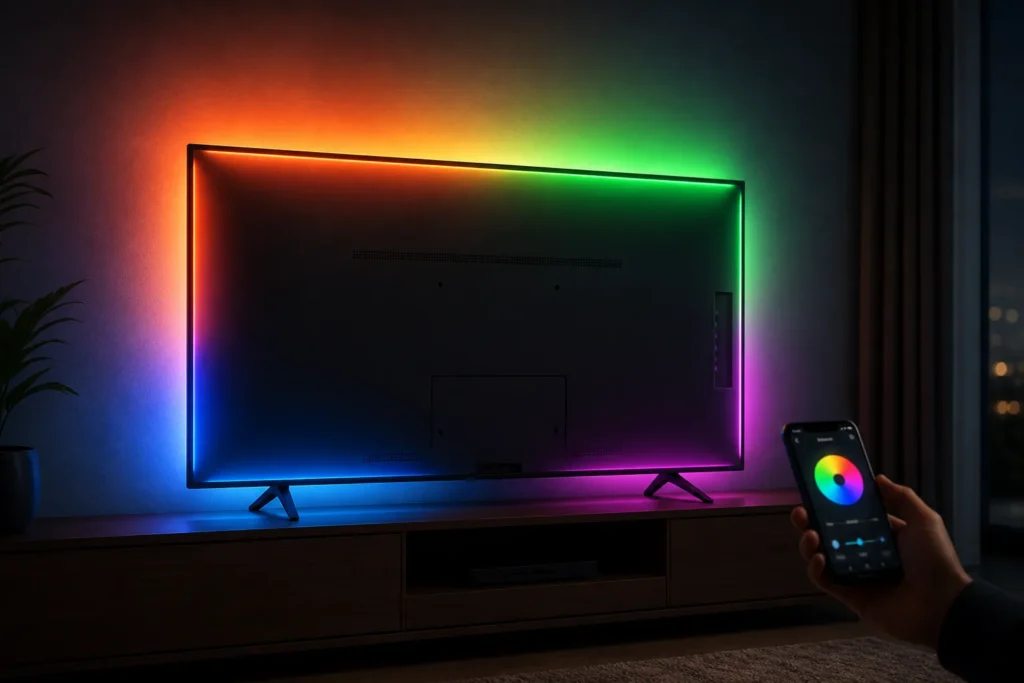
The uLamp app is presented as the control centre for this TV LED backlight. Its listed functions include TV Sync, Scene Modes, Music Sync, and DIY colour customisation, giving you several ways to use the lighting beyond automatic screen matching.
Music control includes six named modes: Rock, Jazz, Classical, Scroll, Energy, and Spectrum. The description positions Energy for lively gatherings and Jazz for warmer, quieter evenings. It doesn’t specify the audio connection method, so you should avoid assuming that every phone, television, or music source will work in the same way.
The app also lists preset scenes across Landscape, Life, Festival, and Feeling categories. Examples include Iceland Blue and Snowy Cabin. These presets could be useful when you want a ready-made room mood instead of manually selecting individual colours.
- Open or install the uLamp app and confirm that the lighting can be accessed.
- Test TV Sync with varied screen content rather than a single still image.
- Cycle through Landscape, Life, Festival, and Feeling to see whether the presets suit your room.
- Try all six music modes, including a quiet listening session and a more energetic one.
- Use DIY colour customisation and decide whether the controls are convenient enough for regular use.
For this TV LED backlight, the app feature list is a strong part of the proposition, but convenience is personal. The practical test is whether you can reach your preferred mode quickly without repeated setup or confusing controls.
Automatic Power Control and Energy Class G
Automatic operation is one of the more practical features of this TV LED backlight. The product description says the lighting turns on about seconds after the television powers up and switches off roughly five minutes after the TV is turned off.
That timing is designed to remove a repetitive task. You shouldn’t need to find a separate control every time you sit down to watch something, and the delayed shutoff is intended to prevent the lights remaining on indefinitely after viewing ends.
The trade-off is the listed Energy Class G rating. The supplied data does not include a wattage figure, annual consumption estimate, or electricity-cost calculation, so you cannot use the listing alone to determine how much operation will add to your bill.
Keep the displayed price and ongoing use separate when judging value. The listed price is USD0.00, but that figure says nothing about electricity consumption, and the available information isn’t sufficient to convert the energy class into a personal running-cost estimate.
When assessing this TV LED backlight, decide how much automatic shutoff matters to you, then weigh that convenience against your preference for clearer energy specifications. The timer may make daily use easier, but it doesn’t remove the need to consider the stated energy classification.
What Customers Are Saying About This TV LED Backlight
No overall star rating or review count is supplied in the product data provided for this TV LED backlight. That means there is no reliable customer-review record here from which to claim that buyers commonly praise the colour accuracy, app, installation, or automatic power behaviour.
Because the record is unavailable, you should treat recurring themes as questions to investigate rather than established findings. Look for several independent comments about whether the four-zone effect is visibly different from a single-zone system, whether the sensor stays secure on top of the television, and whether the lighting follows changes without noticeable delay.
App usability deserves the same scrutiny. If customer comments are available on the live listing, check whether users describe TV Sync, scene selection, music modes, and DIY controls as straightforward. Isolated criticism may reflect one installation or phone environment, whereas repeated reports of the same issue would deserve more weight.
Installation feedback should cover the adhesive strip, sensor stability, and compatibility with thin televisions. You should also look for evidence about automatic activation and shutoff rather than assuming the stated timing works identically with every television.
Several useful questions remain unanswered by the supplied information: how long the adhesive remains secure, what exact calibration steps are required, and how consistently the system behaves across different TV brands. Until a review record is available, this TV LED backlight should be judged on its documented design rather than on unverified buyer sentiment.
TV LED Backlight Comparison With Alternatives
Comparing this TV LED backlight with named alternatives is difficult because verified specifications, prices, ratings, and review counts for the competitors were not supplied. The Govee TV Backlight Lite and Philips Hue Play Gradient Lightstrip are relevant names to investigate, but it would be misleading to assign them features or prices that aren’t present in the available data.
| Feature | Product reviewed here | Govee TV Backlight Lite | Philips Hue Play Gradient Lightstrip |
|---|---|---|---|
| Sensor or camera approach | Top-mounted optical sensor with four sensing zones | Not supplied | Not supplied |
| TV-size compatibility | 55–65-inch ultra-thin TVs | Not supplied | Not supplied |
| App controls | uLamp app with TV Sync, scenes, music, and DIY colour control | Not supplied | Not supplied |
| Music features | Six listed modes | Not supplied | Not supplied |
| Installation | Gravity-mounted sensor and rear adhesive strip | Not supplied | Not supplied |
| Listed price | USD0.00 | Not supplied | Not supplied |
On the information available, the reviewed product stands out for its four independent sensing zones, scene presets, six music modes, and gravity-mounted top sensor. Those points may matter if you want a wider set of control options than a fixed-colour strip offers.
You should still investigate brightness, LED count, app-platform compatibility, and remote-control support before comparing it seriously with either named alternative. The Energy Class G rating also deserves attention when energy specifications are part of your decision.
For now, this TV LED backlight has a documented feature advantage on paper, but there isn’t enough verified competitor information to declare a winner.
Who Should Buy This 55–65-Inch TV LED Backlight?
This TV LED backlight is aimed at you if your television fits the stated physical limits and you want ambient lighting that follows the screen rather than staying one fixed colour. The best match is someone who values the combination of TV Sync, app scenes, music modes, and automatic operation.
Film viewers may enjoy lighting intended to reflect changing scenes, while gamers may prefer the idea of colour transitions accompanying fast on-screen movement. Music listeners can explore the six named modes, and anyone who likes preset room moods may find the scene categories more convenient than selecting colours manually.
It is a weaker fit for a television outside the supported size range, a set thicker than the stated limit, or a screen whose top edge cannot safely hold the sensor. It may also be unsuitable if the rear panel offers no practical surface for the adhesive strip.
- Measure the television and confirm that its physical dimensions fit the listing.
- Check the thickness limit before considering the lighting layout.
- Inspect the top edge for a stable, unobstructed sensor position.
- Inspect the rear surface for a suitable adhesive mounting area.
- Decide whether app-based controls meet your needs before relying on the scene and music features.
Choose this TV LED backlight when active screen effects and room-mood controls are more important than a basic decorative strip. If your priorities are broad compatibility or thoroughly documented energy performance, the supplied information leaves more to verify.
Value Assessment at USD0.00
At the listed price of USD0.00, this TV LED backlight appears to offer an unusually broad feature set: four-zone colour sensing, a claimed 0.05-second response, 4.5M of lighting, six music modes, scenes, app control, and automatic power timing.
However, verify the current displayed price before purchase. A zero-price listing may depend on availability, listing status, or information that changes, so you shouldn’t make a buying decision until the amount shown to you is clear.
Compared with a simpler single-zone or fixed-colour strip, the appeal is added synchronisation and control rather than a claimed monetary saving. The four-zone design is intended to give different parts of the room lighting a closer relationship with different parts of the picture, while the app adds music and mood options.
The limitations are significant for a value assessment. The product carries an Energy Class G rating, but no power-consumption figure, brightness measurement, LED count, customer star rating, or review count is supplied. Those omissions make it difficult to judge running costs, light output, reliability, or how well the system works in ordinary homes.
Use this buying framework: choose the TV LED backlight if four-zone syncing, app scenes, and automatic control matter to you and your television fits the stated requirements. Reconsider it if your set falls outside those limits, if energy specifications are a priority, or if you need established customer feedback before committing.
Pros and Cons
Pros
- Four independent sensing zones are designed to follow different areas of the screen rather than one overall colour.
- The uLamp app combines TV Sync, six music modes, scene presets, and DIY colour customisation.
- Automatic power timing reduces the need to operate the lighting manually each time you watch TV.
- The gravity-mounted sensor is adjustable, while the included adhesive strip is intended to secure the lighting on the TV’s rear surface.
Cons
- The Energy Class G rating may concern shoppers who prioritise energy efficiency.
- No wattage, annual electricity-consumption figure, brightness measurement, or LED count is supplied.
- The listing provides no customer star rating or review count, so real-world reliability and calibration are difficult to assess.
- Compatibility depends on a suitable top edge for the sensor and a usable rear surface for the adhesive strip.
- Competitor specifications and pricing were not supplied, so a fully verified value comparison isn’t possible.
Final Verdict
Key Takeaways
- The four-zone optical sensor is the product’s main differentiator, designed to match separate screen areas rather than one overall colour.
- The uLamp app lists TV Sync, six music modes, preset scenes, and DIY colour customisation.
- Automatic activation and shutoff are convenient, but the Energy Class G rating is not supported by wattage or annual-consumption figures.
- No customer rating or review count was supplied, so colour accuracy, app reliability, adhesive durability, and cross-brand compatibility remain unverified.
- Verify the USD0.00 listing price and confirm your TV’s size, thickness, top-edge sensor position, and rear mounting surface before purchase.
Frequently Asked Questions
What size TVs is this TV LED backlight compatible with?
The product is intended for 55–65-inch ultra-thin televisions, with a stated maximum TV thickness of 1.57 inches. The top edge must also provide a suitable, unobstructed position for the gravity-mounted optical sensor.
Does the lighting turn on and off automatically?
The product description states that the sensor turns the lighting on about seconds after the television powers up and switches it off roughly five minutes after the TV is turned off.
![See the TV LED Backlight with 4-Zone Sensor, RGB Color Sync for 55-65 Inch TV, 4.5M [Energy Class G] in detail.](https://zivzi.co.uk/wp-content/uploads/2024/02/purchase-now-amber-1.png "See the TV LED Backlight with 4-Zone Sensor, RGB Color Sync for 55-65 Inch TV, 4.5M [Energy Class G] in detail.")
What can you control through the uLamp app?
The uLamp app includes TV Sync, Scene Modes, Music Sync, and DIY colour customisation. It also lists preset scenes and six music modes.
What information is missing before purchase?
The available product information does not include an overall star rating, review count, wattage figure, annual energy consumption, brightness measurement, LED count, or confirmed platform compatibility details for the app.
Disclosure: As an Amazon Associate, I earn from qualifying purchases.
![See the TV LED Backlight with 4-Zone Sensor, RGB Color Sync for 55-65 Inch TV, 4.5M [Energy Class G] in detail.](https://zivzi.co.uk/wp-content/uploads/2024/02/check-price-amber-4.png "See the TV LED Backlight with 4-Zone Sensor, RGB Color Sync for 55-65 Inch TV, 4.5M [Energy Class G] in detail.")
